
Starting doses and what to expect

You can build up to the right dose of Qelbree in as soon as 1-2 weeks. Dosing is a journey, stick with it!

Decorative
Components

Building to an effective dose takes time

Content Block Description

The dose of Qelbree may be adjusted weekly as needed to optimize control of your ADHD symptoms.*

Your healthcare provider will typically start you on a lower dose and increase it gradually over the first 1-2 weeks until you reach the dose that’s right for you, adjusting as needed.

This could be anywhere from 200 mg to 600 mg/day for adults. This process is called titration.

*Your healthcare provider will determine the dose based on your response to medication.
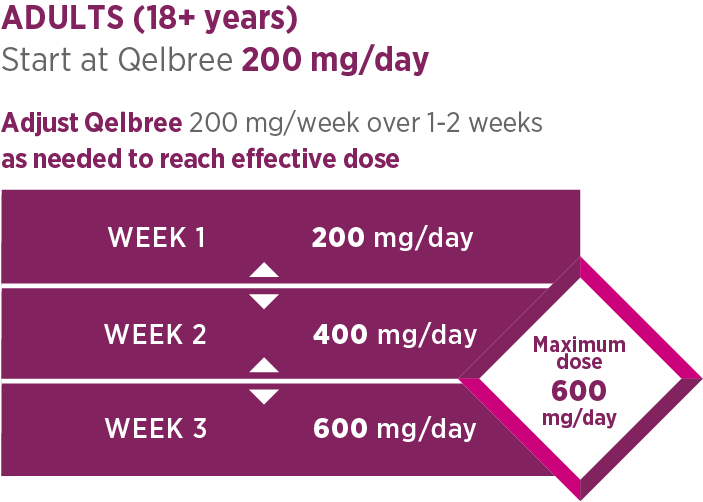
Qelbree's titration schedule for adults ages 18 and older, starts at 200 mg/day in week 1 and increases weekly to a maximum dose of 600 mg/day by week 3.
Your journey to ADHD symptom control
Feature List Description

If you have tried other ADHD medications, you may have a different experience with Qelbree. It could take a few weeks for your medication to feel fully effective.

It’s important to know:

Feature List Items
Feature List Item Icon
Feature List Item Description
Qelbree is a non-stimulant medication and has a “gradual onset.” It could take a few weeks for the medication to be fully effective.
Feature List Item Icon
Feature List Item Description
Qelbree provides a foundation of 24-hour coverage—avoiding peaks and crashes commonly experienced with most stimulant medications.
Speedbump Description

Qelbree is proven to work in medical studies that were conducted over 6 or 8 weeks—showing significant reduction in ADHD symptom scores in 4 medical studies of more than 1400 people.

Qelbree met the goal in the adult medical study—a significant reduction in ADHD symptom scores in 6 weeks. Qelbree reduced ADHD symptom scores as early as Week 2 for adults.

Taking a week-by-week approach can help you with starting Qelbree

Managing your ADHD is a journey. Here are some things you can do each week to help with your Qelbree experience when starting out.

Tasks for weeks 1 and 2

It is important to keep all follow-up visits with your healthcare provider and to monitor mood or behavior changes as well as any other side effects while taking Qelbree.

Fifty Fifty Left
Media Block Image
Fifty Fifty Right
Stick with it!
Content Block Description

Like many ADHD medications, reaching your best daily dose of Qelbree may take some time. Make sure you stick with your treatment, and check in with your healthcare provider about your progress.

If you’re struggling with symptoms or experiencing side effects, let your healthcare provider know. Sometimes, even small adjustments to your treatment dose can make a big difference.

Use the Qelbree Progress Tracker to help keep track of your experience as you find the right dose of Qelbree.


Testimonial Mobile Image
Testimonial Image

When I started Qelbree, the cloud lifted.”

Michele
Testimonial Author Description

Parent with ADHD
Paid spokesperson for Qelbree

Are you switching from another ADHD treatment? It’s common.

Your healthcare provider will advise on what your individualized treatment plan looks like.

Of the children, teens, and adults who switched to Qelbree:

Stats Cards
49%

switched to Qelbree from a controlled substance or stimulant medication

51%

switched to Qelbree from other non-stimulant ADHD meds

More tips for success
You’ve got this. Find more tips for success when starting Qelbree.

IMPORTANT SAFETY INFORMATION ABOUT QELBREE

INDICATION

Qelbree® (viloxazine extended-release capsules) is a prescription medicine used to treat Attention-Deficit/Hyperactivity Disorder (ADHD) in adults and children 6 years and older.

IMPORTANT SAFETY INFORMATION
Qelbree may increase suicidal thoughts and actions, in children and adults with ADHD, especially within the first few months of treatment [read more] or when the dose is changed. Tell your doctor if you or your child have (or if there is a family history of) suicidal thoughts or actions before starting Qelbree. Monitor your or your child’s moods, behaviors, thoughts, and feelings during treatment with Qelbree. Report any new or sudden changes in these symptoms right away.

IMPORTANT SAFETY INFORMATION
Qelbree may increase suicidal thoughts and actions, in children and adults with ADHD, especially within the first few months of treatment or when the dose is changed. [read more] Tell your doctor if you or your child have (or if there is a family history of) suicidal thoughts or actions before starting Qelbree. Monitor your or your child’s moods, behaviors, thoughts, and feelings during treatment with Qelbree. Report any new or sudden changes in these symptoms right away.

You should not take Qelbree if you or your child:
Take a medicine for depression called a monoamine oxidase inhibitor (MAOI) or have stopped taking an MAOI in the past 14 days. Also, you or your child should avoid alosetron, duloxetine, ramelteon, tasimelteon, tizanidine, and theophylline.

Qelbree can increase blood pressure and heart rate. Your or your child’s doctor will monitor these vital signs.

Qelbree may cause manic episodes in patients with bipolar disorder. Tell your doctor if you or your child show any signs of mania.

Do not drive or operate heavy machinery until you know how Qelbree will affect you or your child. Qelbree may cause you or your child to feel sleepy or tired.

The most common side effects of Qelbree in patients 6 to 17 years are sleepiness, not feeling hungry, feeling tired, nausea, vomiting, trouble sleeping, and irritability, and in adults, insomnia, headache, sleepiness, tiredness, nausea, decreased appetite, dry mouth, and constipation. These are not all the possible side effects of Qelbree.

You are encouraged to report negative side effects of prescription drugs to the FDA. Visit www.fda.gov/medwatch or call 1-800-FDA-1088.

Please see Medication Guide, including Boxed Warning.

IMPORTANT SAFETY INFORMATION ABOUT QELBREE

INDICATION

Qelbree® (viloxazine extended-release capsules) is a prescription medicine used to treat Attention-Deficit/Hyperactivity Disorder (ADHD) in adults and children 6 years and older.

IMPORTANT SAFETY INFORMATION
Qelbree may increase suicidal thoughts and actions, in children and adults with ADHD, especially within the first few months of treatment [read more] or when the dose is changed. Tell your doctor if you or your child have (or if there is a family history of) suicidal thoughts or actions before starting Qelbree. Monitor your or your child’s moods, behaviors, thoughts, and feelings during treatment with Qelbree. Report any new or sudden changes in these symptoms right away.

IMPORTANT SAFETY INFORMATION
Qelbree may increase suicidal thoughts and actions, in children and adults with ADHD, especially within the first few months of treatment or when the dose is changed. [read more] Tell your doctor if you or your child have (or if there is a family history of) suicidal thoughts or actions before starting Qelbree. Monitor your or your child’s moods, behaviors, thoughts, and feelings during treatment with Qelbree. Report any new or sudden changes in these symptoms right away.

You should not take Qelbree if you or your child:
Take a medicine for depression called a monoamine oxidase inhibitor (MAOI) or have stopped taking an MAOI in the past 14 days. Also, you or your child should avoid alosetron, duloxetine, ramelteon, tasimelteon, tizanidine, and theophylline.

Qelbree can increase blood pressure and heart rate. Your or your child’s doctor will monitor these vital signs.

Qelbree may cause manic episodes in patients with bipolar disorder. Tell your doctor if you or your child show any signs of mania.

Do not drive or operate heavy machinery until you know how Qelbree will affect you or your child. Qelbree may cause you or your child to feel sleepy or tired.

The most common side effects of Qelbree in patients 6 to 17 years are sleepiness, not feeling hungry, feeling tired, nausea, vomiting, trouble sleeping, and irritability, and in adults, insomnia, headache, sleepiness, tiredness, nausea, decreased appetite, dry mouth, and constipation. These are not all the possible side effects of Qelbree.

You are encouraged to report negative side effects of prescription drugs to the FDA. Visit www.fda.gov/medwatch or call 1-800-FDA-1088.

Please see Medication Guide, including Boxed Warning.